
Peoria County Juvenile Detention Center Overview
The Peoria County Juvenile Detention Center is a secure juvenile facility connected to the Tenth Judicial Circuit. It holds minors detained through the juvenile court system, which is a separate track from the adult jail run by the sheriff. The center is on the county justice campus on North Maxwell Road, near the adult jail but operating under different rules and a different population. It was dedicated and opened in the summer of 1999.
The facility pairs secure custody with services aimed at young people. The official page describes education, mental health, medical, dental, and faith-based services brought together in one setting. Its core values stress dignity, accountability, and the belief that young people are capable of change. That service focus marks the difference between a juvenile center and an adult jail.
The center is one of several justice facilities clustered on the Maxwell Road campus, which can confuse visitors. The adult jail sits at 301 North Maxwell Road, while the juvenile center sits nearby at 223 North Maxwell Road. They are run by different authorities, hold different populations, and follow different visitor rules, so it is worth confirming the right building and the right office before you set out.
Juvenile Detention vs. the Adult Jail
It helps to compare the juvenile center directly with the adult jail, since the two are easy to confuse. The biggest difference is privacy. Adult jail records are largely public and searchable, while juvenile detention records are confidential and not posted as a roster. The table below lays out the main contrasts.
| Juvenile Detention Center | Adult County Jail | |
|---|---|---|
| Who Is Held | Minors under the juvenile court | Adults in county custody |
| Run By | Tenth Judicial Circuit / county | Peoria County Sheriff |
| Public Roster | No, records are confidential | Yes, searchable online |
| How to Reach | Court and facility directly | Records portal and inmate line |
Because of these differences, the search steps that work for an adult relative do not apply to a minor in juvenile custody. The right contact for a young person is the juvenile court or the facility, not a public lookup.
Peoria County Juvenile Detention Center Capacity
The center is a sixty-three-bed secure facility for juveniles. Its population is not published as a public roster the way an adult jail count might be, because juvenile detention information is protected. The stat block below shows the verified capacity and the year the center opened.
Because the center serves minors, its records are not part of the adult public roster, and counts are reported through the court and oversight channels rather than an online lookup.
How Juvenile Detention Records Differ From the Adult Roster
There is no public juvenile roster to search the way you would search the adult jail. Juvenile detention records are confidential, tied to the juvenile court, and not posted online. Families and attorneys work through the court and the facility rather than a public locator. If you are looking for an adult instead, use the county jail records and the sheriff's inmate information line.
- Confirm whether the person is a minor in juvenile custody or an adult in the county jail.
- For a minor, contact the juvenile court or the detention center directly, since there is no public roster.
- For an adult, use the sheriff's county jail records portal and inmate information line instead.
- Respect that juvenile information is protected and is shared only with authorized parties.
Peoria County Juvenile Detention Center Address and Contact
The center is located on North Maxwell Road, near the adult jail but as a separate facility. Visits are arranged through an online scheduling link rather than a public phone roster line. The contact card below lists the address and the operating context.
Peoria County Juvenile Detention Center
223 N. Maxwell Road
Peoria, IL 61604
Tenth Judicial Circuit
Visits scheduled through the facility's online booking link
Confirm you are heading to the juvenile center and not the adjacent adult jail, since the two facilities sit close together but follow very different visitor rules.
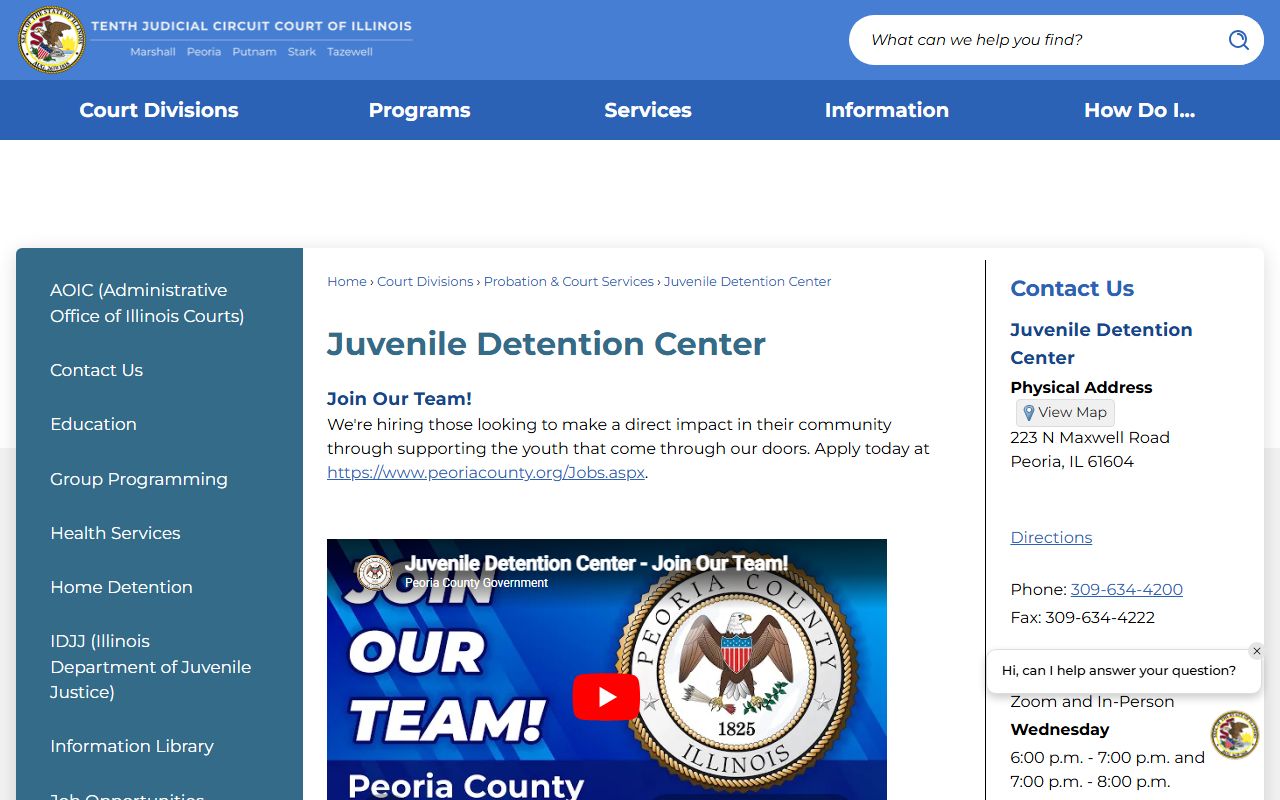
The facility page also carries the mission statement, the services list, and the visitation schedule that families need.
Visiting Someone at the Peoria County Juvenile Detention Center
Juvenile visitation runs on set windows and uses both Zoom and in-person visits, which differs from the adult jail's weekly model. Visits are scheduled through an online booking calendar. The schedule below shows the visiting windows.
| Day | Hours | Type |
|---|---|---|
| Wednesday | 6:00 p.m. - 7:00 p.m. and 7:00 p.m. - 8:00 p.m. | Zoom / In-person |
| Saturday | 1:00 p.m. - 2:00 p.m. and 2:00 p.m. - 3:00 p.m. | Zoom / In-person |
Because the residents are minors, visits are arranged with care for the young person and through the facility's scheduling system, not by simply arriving at the door. Confirm the current schedule before planning a visit.
Programs and Services at the Center
The center is built around services as much as security. It brings together education, mental health care, medical and dental care, and faith-based support for the young people in its care. The table below summarizes the service areas the facility describes.
| Service | Detail |
|---|---|
| Education | Schooling provided to residents during their stay |
| Health care | Mental health, medical, and dental services |
| Faith-based support | Faith-based services offered alongside care |
The stated mission is to provide a safe, caring environment that guides children toward productive lives while enhancing community safety. That balance of care and security shapes daily life at the center. Education continues during a stay so a young person does not fall behind, and the health and faith-based services round out a model built around support rather than punishment alone. These services are a core reason the juvenile center is treated as its own kind of facility, distinct from the adult jail next door.
How Young People Are Detained Here
Admission to the center comes through the juvenile court process, not a street arrest and adult booking. A minor is detained by order of the juvenile court system rather than logged onto a public adult roster. This is why the path to information runs through the court and the facility, and why juvenile detention records are not mixed with the adult jail's online records. The protections around juvenile information are stronger than for adult custody.
The juvenile court system treats detention as a measured step, aimed at safety and a path back to a productive life rather than long-term confinement. That framing shapes how the center operates day to day, from its services to its visitation. It also explains why the public-facing details are limited. Where an adult jail publishes a roster and booking records, the juvenile center shares its mission, its capacity, and its visiting schedule, while keeping individual resident information inside the court process.
About the Peoria County Juvenile Detention Center
Opened in the summer of 1999, the center has served as the county's secure juvenile facility for more than two decades. Its core values emphasize responding to complex needs, engaging community support, and treating young people with dignity and respect. The center also holds that accountability promotes a safer community and that young people are capable of change, which guides its daily approach. Oversight includes annual inspection by the state's juvenile justice authority, and a recent inspection result reported the center in compliance.
For families, the practical guidance is to keep the juvenile and adult systems separate in your mind. A minor in this center is reached through the juvenile court and the facility's scheduling, with privacy protections built in. An adult relative is a different search entirely, handled through the county jail and the jail inmate records page, the sheriff's inmate information line, and the public records portal. Confusing the two only slows things down, so confirm first whether the person is a juvenile or an adult, then follow the matching path.
Note: Juvenile records are confidential, so confirm custody and visits through the court or the facility rather than expecting a public roster.