
Peoria County Court Records After a Jail Arrest
After a Peoria County arrest, the booking creates a jail record, but the court record begins a step later. The Peoria County State's Attorney's Office is the local prosecutor, and its Charging Division decides whether criminal charges should be filed against an adult in a felony or misdemeanor case. That decision is why the booking charge and the filed court charge are not always the same. The charge a court reviews is the one the prosecutor files, not the label an officer used at the jail.
The two sides of a case live in two systems. The booking and custody side stays on the jail roster, and you can read it through jail inmate records for custody detail or jail roster mugshots for booking photos. The court record itself, meaning the charges the prosecutor filed and how they move through hearings, lives in the court case system. This page follows the path from the arrest into those court records.
From a Peoria County Arrest to a Court Case
The path from an arrest to a court record runs through a few fixed steps, and each one adds to what the public record holds. The short flow reads: arrest, then booking, then first appearance, then the prosecutor files charges, then the case opens in court. The jail record captures the early part, and the court record takes over once charges are filed.
- Arrest or warrant service puts a person into county custody.
- Booking at the jail creates the custody record and the booking charge.
- A first appearance addresses rights, release conditions, and scheduling.
- The State's Attorney's Charging Division decides what charges to file.
- The filed case opens in the court docket and becomes the court record.
The State's Attorney, Jodi M. Hoos, leads the office that makes that charging call, and the elected-officials role of the office is to prosecute criminal defendants in the county. Because the prosecutor reviews the case before filing, the booking charge can be amended, reduced, or dropped by the time the court record is set. The county also supports VINELink, so a victim or concerned citizen can register for notice of a release, an escape, or a court appearance tied to the case.
How to Find Peoria County Court Records After an Arrest
Filed charges and case activity are searched through the County Justice Public Access Site. The county confirms the portal is free, and the general public does not need to register to search court records, though attorneys and law enforcement are encouraged to register. Civil, criminal, and traffic dockets are available there. The booking and arrest detail stays on the jail roster, so the court portal is for the charges and the case, not the custody photo.
- Open the County Justice Public Access Site from the county's Courts and Legal Services page.
- Search by the defendant's name, or by a case number if you have one.
- Open the case and read the list of filed charges.
- Check each charge for its level, its current status, and the next hearing.
Case numbers follow Illinois patterns such as 2024-CF-0000321 for a felony or 18-CM-00143-1 for a misdemeanor, where CF and CM mark the charge level. A warrant record can hand you that case number, which makes the court search faster.
The County Justice Public Access Site below is the official free search for Peoria County court records.
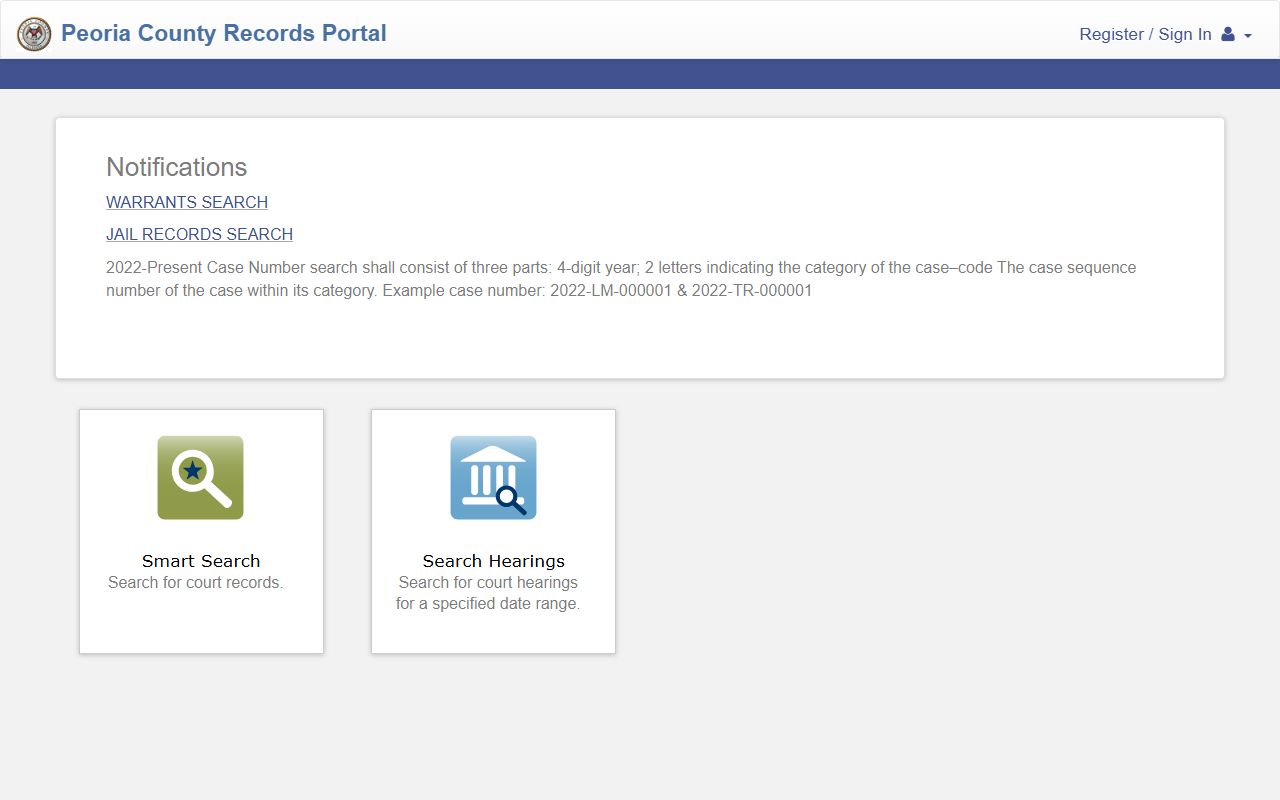
Because the search is free and open, it is the first place to confirm whether charges were filed after an arrest.
How Peoria County Charges Get Filed After an Arrest
Booking happens at the jail, then the charge record opens when the prosecutor files a charging document. Illinois uses three main types. A complaint is common for misdemeanors. An information is filed by the prosecutor and is common for felonies. An indictment comes from a grand jury and is used for serious felonies. Each one starts the formal case that becomes the court record.
| Complaint | Information | Indictment | |
|---|---|---|---|
| Filed By | Officer / Prosecutor | Prosecutor | Grand Jury |
| Common For | Misdemeanors | Many felonies | Serious felonies |
| Starts | The case | The case | The case |
Note: The charging decision sits with the State's Attorney, so a person booked on one offense may be formally charged with a different or amended count.
Peoria County Charge Status After an Arrest
Charges shift as a case moves, and the court record tracks each change. A charge can be amended, reduced, added, or dropped, and the booking charge on the jail roster can differ from the final filed charge. Reading the status terms keeps the record clear. The table below defines the ones that show up most often.
| Status | What It Means |
|---|---|
| Pending | The charge or case is still active and not yet resolved. |
| Amended / Reduced | The prosecutor changed the charge language or lowered the severity. |
| Dismissed | The charge ended without a conviction. |
| Nolle Prosequi | The prosecutor chose not to pursue the charge, ending it without a conviction. |
| Disposition | The final outcome recorded for a charge or the whole case. |
Bond and Release After a Peoria County Arrest
Bond in Peoria County is handled at the jail and shaped by the court. The bonding lobby accepts cash, money order, or cashier's check around the clock, with a sixty-dollar processing fee per case on top of the bond amount. A credit-card bond can be processed by phone through Court Money with a seven percent fee. Bond amounts can change at a court appearance once a judge reviews the charges. Illinois has moved away from traditional cash bail under its pretrial release reforms, so the current court order or warrant controls, and broad bail-bondsman advice no longer fits the state.
| Bond Type | How It Works |
|---|---|
| Cash / money order / cashier's check | Accepted in the bonding lobby around the clock, plus a sixty-dollar per-case fee. |
| Credit-card bond | Processed by phone through Court Money with a seven percent fee. |
| Warrant bond | Usually ten percent of the warrant amount plus a booking fee, which sets a new court date. |
| No-bond hold / detainer | A hold that money alone will not clear; confirm it with the jail. |
A person who wants eligible bond money returned to them must complete a surety form when the bond is posted, or the refund goes to the inmate's last known address.
Warrants That Lead to a Peoria County Arrest
Many arrests start with an outstanding warrant. The county publishes a warrant list with a name, an offense, and a case number, but it is a subset of felony and misdemeanor warrants, it updates once every twenty-four hours, and recent changes may not show. The county warns that only a peace officer can arrest a person on a warrant, and that warrants must be verified through the sheriff before any action. The case number on a warrant record is the bridge into the court docket.
The county warrant list below shows the name, offense, and case number for each entry.
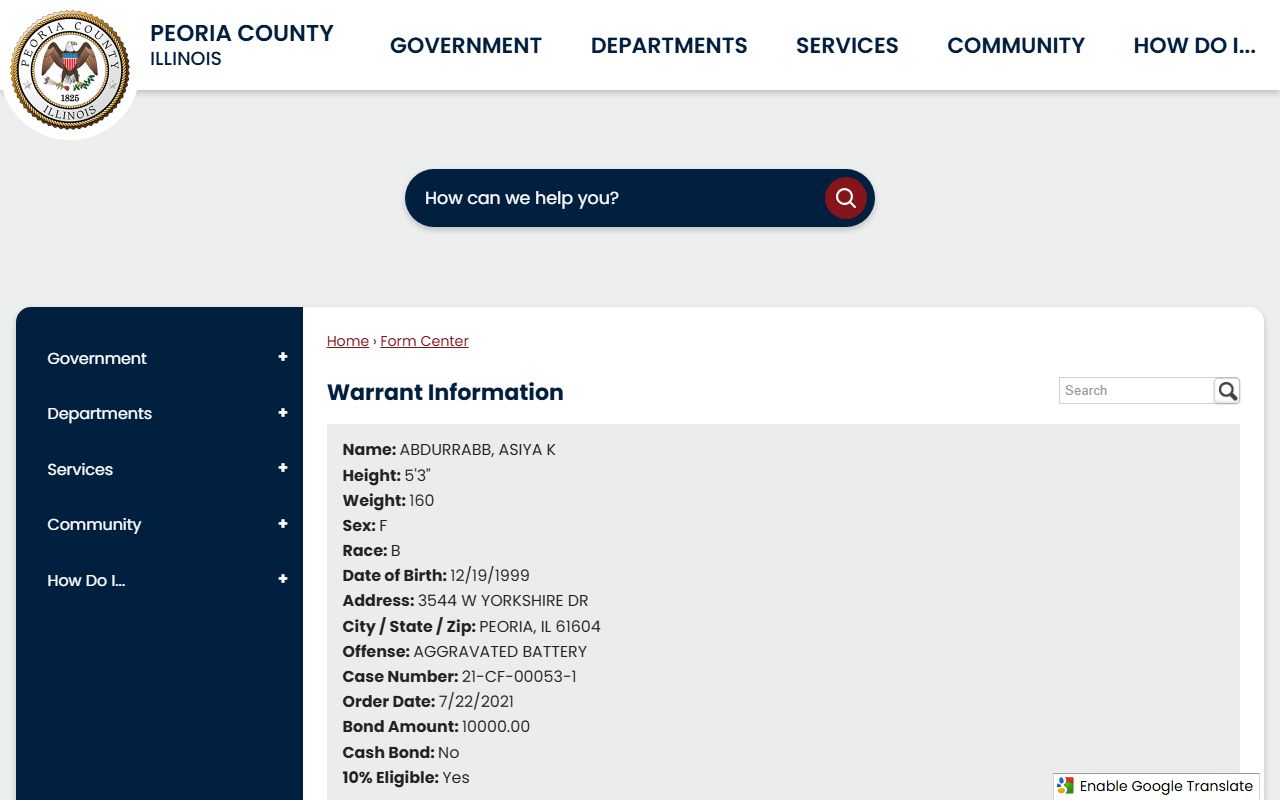
Anyone with information on a wanted person is told to call dispatch at 309-672-6011 rather than approach the person, since the list is a tip resource and not a complete record.
Peoria County Charges vs. Convictions
Being arrested and charged is not the same as being convicted. A charge is an accusation that opens a case, while a conviction is a finding of guilt by plea or verdict. The court record shows both stages, and the difference matters when reading any case.
| Charge | Conviction | |
|---|---|---|
| Stage | Accusation | Verdict or plea |
| Burden of Proof | Probable cause | Beyond a reasonable doubt |
| Public Record | Yes | Yes |
Sealed vs. Expunged Records After an Arrest
A dismissed or eligible case may later be cleared. Illinois handles this through its Criminal Identification Act, which governs criminal history records and the routes to seal or expunge them. Sealing hides a record from most public view while leaving limited access for some agencies. Expungement goes further and treats the record as though it never existed. Eligibility depends on the offense and the outcome, so the court is the place to confirm what applies.
| Sealed | Expunged | |
|---|---|---|
| Visibility | Hidden from public view | Destroyed or treated as never existing |
| Law Enforcement | Limited access | Very limited access |
| Eligibility | Set by Illinois law and the disposition | Often after a dismissal or an eligible outcome |
Background Check Considerations
A casual court-record lookup is not the same as a regulated background check. A formal background check for hiring, housing, or credit must follow the Fair Credit Reporting Act and use a licensed consumer reporting agency. Reading a free court docket out of personal interest does not, but it also cannot be used for those regulated decisions.
Important: This site is not a consumer reporting agency under the FCRA, and nothing here may be used for employment, housing, credit, or insurance screening.
Restricted Court Records After an Arrest in Peoria County
Some records after an arrest are not open to the public. Juvenile matters are handled apart from the adult court and are not on the adult docket. Sealed and expunged cases are removed from public search. Dismissed charges may be withheld in some circumstances, and an ongoing investigation can keep records closed for a time. For jail and corrections records that are not online, the sheriff's FOIA process is the route, while court files are pulled through the court portal or the circuit clerk rather than the sheriff.